
Written by webtechs

Can Couples Live Together In Assisted Living?

Can Couples Live Together In Assisted Living?

Can Couples Live Together In Assisted Living?

A move to assisted living does not always begin with two people needing the same amount of help. Often one spouse is managing well while the other is struggling with dressing, medication, meals, mobility, or the demands of running a home. That leaves many families asking a practical question: can couples live together in assisted living?

In many communities, the answer can be yes, provided the apartment, care assessment, and services suit both people. A couple does not have to receive identical care simply because they share a home.

Each Spouse Can Have Different Support Needs

Assisted living care is usually based on the individual. One spouse may need help getting ready in the morning and reminders with medication, while the other remains largely independent. An assessment helps the community understand what each person can do safely and where assistance would make daily life easier.

That arrangement can stop the relationship from becoming defined entirely by caregiving. The spouse who has handled meals, laundry, transportation, or personal care at home may finally return to being a husband or wife rather than an exhausted full time caregiver.

Ask how separate care plans are created, how changes are reviewed, and which services are included in the apartment charge.

Choose A Floor Plan That Fits Real Life

A couple may be comfortable in a one bedroom apartment, but others need more room for privacy, hobbies, visitors, or different sleep schedules. A two bedroom layout can also help when one person uses mobility equipment or needs a quiet place to rest.

Measure the furniture that genuinely matters before moving day. Keep the favorite chairs, photographs, lamps, and practical pieces that make the new place recognizable, then leave enough clear space to move safely.

Ventana Winds offers one bedroom, deluxe one bedroom, and two bedroom assisted living floor plans. Its two bedroom option includes two bathrooms, which may be useful for couples with different routines or personal care needs.

Ask How Costs Are Calculated For Two People

Request a written explanation of the apartment charge and any care charges connected to each resident. Do not assume that one monthly figure covers both people or that the spouse needing less support will pay the same care amount.

Ask about meals, laundry, housekeeping, utilities, transportation, emergency call systems, and personal care. It is also sensible to ask what happens financially when one spouse needs additional assistance later.

A fair comparison should include the cost of remaining at home. Groceries, property upkeep, utilities, transportation, home care, and unpaid family caregiving still count even when the mortgage has gone.

Plan For Changes Before They Become Urgent

Health needs rarely remain fixed. One spouse may recover strength after a move, while the other may begin to require more help. Ask how the community responds when care needs change and whether a new assessment can be completed without another immediate move.

Couples should also discuss what matters most if their needs eventually become very different. Some want to remain in the same apartment for as long as possible. Others care more about staying within the same community and visiting easily. Having that conversation early is kinder than making every decision during a crisis.

Tour The Community As A Couple

Both partners should have the chance to ask questions and picture an ordinary week. Look beyond the lobby. Walk the route to dining, see the apartment layouts, ask about transportation and activities, and find out how much choice residents have in their daily routine.

The right community should support the spouse who needs care without making the other person feel that independence has disappeared.

Explore Assisted Living For Couples At Ventana Winds

Ventana Winds offers spacious assisted living apartments in Youngtown near Sun City, including a two bedroom, two bathroom floor plan. Residents receive an individual assessment, and monthly services include meals, housekeeping, laundry, activities, transportation, utilities, 24 hour staffing, and an emergency call system. Call 623 624 4406 to schedule a tour and discuss how assisted living could work for both members of your household.

Live References

Ventana Winds Assisted Living

https://www.ventanawinds.com/assisted-living.htm

Ventana Winds Floor Plans

https://www.ventanawinds.com/floorplans.htm

National Institute on Aging: Long Term Care Facilities

https://www.nia.nih.gov/health/assisted-living-and-nursing-homes/long-term-care-facilities-assisted-living-nursing-homes

AgingCare: Assisted Living For Couples

https://www.agingcare.com/articles/couples-living-together-assisted-living-144938.htm
Written by webtechs

How To Talk To A Parent Who Refuses Assisted Living

How To Talk To A Parent Who Refuses Assisted Living

How To Talk To A Parent Who Refuses Assisted Living

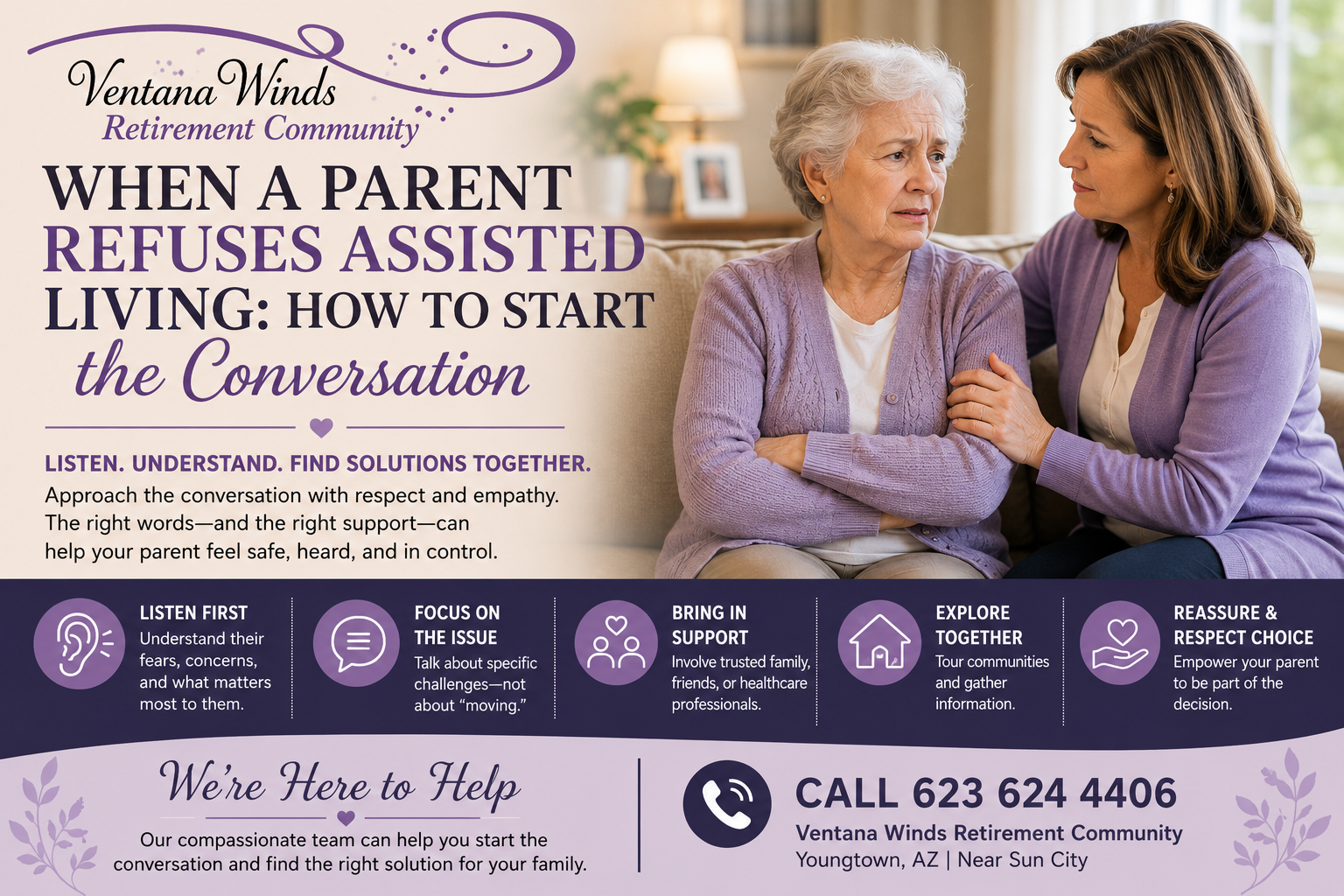
The first conversation about assisted living rarely goes exactly as planned. An adult child arrives with sensible reasons, while the parent hears only one message: you think I can no longer manage my own life.

Learning how to talk to a parent who refuses assisted living begins with listening. Resistance is not always denial or stubbornness. It may come from fear of losing privacy, familiar routines, possessions, neighbours, control, or the identity built around a long held home.

Start With The Problem, Not The Destination

Opening with, “You need to move,” puts the entire conversation on one decision. A better beginning is a specific concern that both people can examine.

Perhaps meals are being skipped. The laundry has become difficult. Driving after dark no longer feels safe. A recent fall has changed confidence. One family member is trying to cover every appointment and household task.

Use plain examples without presenting a prosecution case. “I noticed there was no food in the refrigerator on Sunday” is easier to discuss than “You cannot look after yourself anymore.”

It should identify which parts of daily life are no longer working well.

Ask What Your Parent Wants To Protect

Most older adults value independence, but that word can mean different things. It may mean choosing when to wake up, seeing friends, attending church, or not asking a daughter to handle every small task.

Ask what your parent most wants to preserve. Then discuss whether assisted living could support those priorities. Prepared meals may make it easier to eat regularly. Transportation may protect access to appointments and shopping. Help with housekeeping can leave more energy for enjoyable parts of the day.

Do Not Argue About Every Objection

A parent may say assisted living is only for people who are very ill, the apartments will feel cramped, or everyone will interfere. Correcting every statement immediately can make the conversation feel like a contest.

Ask what is behind the objection. “What worries you most about it?” often reveals more than another list of benefits. The real concern may be money, a pet, privacy, unfamiliar food, or fear that family visits will become less frequent.

Some objections can be answered with facts. Others need time. Repeating the same argument more forcefully rarely makes it more persuasive.

Offer A Tour Without Demanding A Commitment

A tour can replace imagined fears with something concrete. Present it as information gathering, not a trap. Your parent is allowed to dislike the first place, ask difficult questions, and compare options.

Look at an apartment, dining room, outdoor area, and activity calendar. Ask how residents control their routines and how care plans are developed. Let your parent speak directly with staff.

Afterward, do not begin the sales pitch in the car park. Ask what felt comfortable and what did not.

Bring In The Right Outside Voice

Some parents hear concerns more easily from a physician, trusted friend, clergy member, or relative who is not involved in the daily tension. The outside person should not ambush or gang up on them. Their role is to help discuss safety, care needs, and realistic options.

When memory, judgment, or decision making appears to have changed, seek appropriate medical and legal guidance. A family disagreement cannot determine whether someone has the capacity to make their own choices.

Know When Safety Changes The Conversation

A competent adult can make choices other people consider unwise. Families can still set limits on what they are able to provide. It is reasonable to say that one person cannot continue covering overnight supervision, meals, transportation, and personal care alone.

Repeated wandering, serious medication errors, unsafe driving, or an inability to obtain food requires prompt professional help. Safety planning should not wait for the perfect conversation.

Begin A Calmer Assisted Living Conversation At Ventana Winds

Ventana Winds offers assisted living in Youngtown near Sun City with spacious apartments, individualized care plans, chef prepared meals, housekeeping, laundry, activities, transportation, and 24 hour staffing. Call 623 624 4406 to arrange a no pressure tour and give your parent the chance to see the community, ask questions, and take part in the decision.

Live References

Ventana Winds Assisted Living

https://www.ventanawinds.com/assisted-living.htm

AARP: How To Care For An Aging Parent Who Resists Help

https://www.aarp.org/caregiving/life-balance/when-aging-parents-resist-help/

National Institute on Aging: Does An Older Adult In Your Life Need Help?

https://www.nia.nih.gov/health/caregiving/does-older-adult-your-life-need-help

National Institute on Aging: Aging In Place

https://www.nia.nih.gov/health/aging-place/aging-place-growing-older-home

Written by webtechs

When Is It Time For Memory Care? 6 Important Signs


When Is It Time For Memory Care? 6 Important Signs

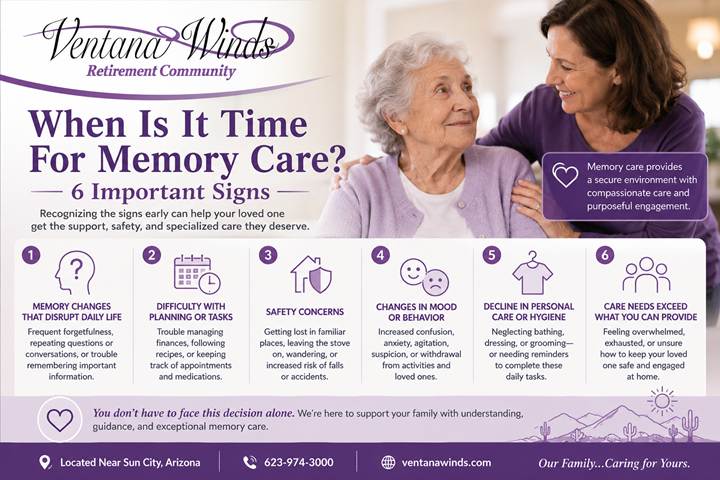
Families rarely receive one unmistakable signal that it is time for memory care. The decision usually develops through a series of changes involving safety, personal care, behavior, health, and the amount of support a person needs each day.

Occasional forgetfulness does not automatically mean someone needs residential memory support. A medical evaluation is important when memory loss or confusion begins affecting daily life. Once a diagnosis has been made, families can watch for practical signs that care at home is becoming difficult or unsafe.

Wandering Or Getting Lost Has Become A Concern

A person living with dementia may leave home unexpectedly, become confused in a familiar neighborhood, or try to return to a place from many years ago. Wandering can happen at different stages of dementia and may place someone at serious risk, particularly during extreme Arizona heat.

Door alarms, identification information, supervision, and changes to the home may help for a time. When a person requires constant monitoring to remain safe, a secured memory care setting may deserve serious consideration.

Everyday Tasks Are No Longer Completed Safely

Look beyond memory lapses and consider how well the person manages ordinary routines. Unopened mail, unpaid bills, spoiled food, missed meals, medication errors, scorched cookware, and poor housekeeping may show that independent living is becoming harder.

Personal hygiene can also change. A loved one may wear the same clothing repeatedly, resist bathing, or forget how to complete familiar tasks. These changes should be discussed with a healthcare professional, since infections, medication effects, depression, and other conditions can sometimes cause sudden confusion.

Behavior Or Personality Has Changed

Dementia can affect judgment, communication, mood, and behavior. A person who was previously relaxed may become suspicious, anxious, withdrawn, or easily agitated. Late afternoon or evening confusion may make care particularly difficult.

Memory care teams are trained to respond to these changes with structure, reassurance, familiar routines, and activities adapted to the resident’s abilities. The goal is not simply to supervise behavior. It is to understand what the person may be communicating through it.

Physical Health Is Declining

Weight loss, dehydration, frequent falls, disrupted sleep, and reduced mobility may suggest that the current care arrangement is no longer meeting every need. A person with dementia may forget to drink, lose interest in food, or have difficulty explaining pain and illness.

Families should seek medical guidance when physical changes appear. If regular meals, hydration, medication support, and daily observation cannot be maintained at home, residential memory care may provide a more consistent routine.

The Family Caregiver Is Exhausted

Caregiver health matters. Constant supervision, interrupted sleep, lifting, personal care, and repeated emergencies can become overwhelming. Exhaustion may affect patience, decision making, work, relationships, and the caregiver’s own health.

Needing additional support is not a failure. It may mean that the level of care has grown beyond what one person or family can safely provide. The National Institute on Aging notes that residential care may become appropriate when an older adult needs more support than relatives and friends can provide.

Home No Longer Provides Enough Engagement

People living with dementia can still benefit from music, conversation, movement, familiar tasks, and meaningful social contact. Isolation may increase when leaving home becomes difficult or a family caregiver has little time left for activities.

A dedicated memory support program can provide a predictable schedule and activities suited to different abilities. Ventana Winds uses its Elements Memory Support program to encourage engagement, individual choice, social connection, and a strength based approach in a secured environment.

Explore Memory Care At Ventana Winds

Ventana Winds provides compassionate memory care in Youngtown near Sun City for people living with Alzheimer’s disease, dementia, and other memory disorders. Families can learn about the Elements Memory Support program, secured accommodations, dining, activities, and current availability by calling Ventana Winds at 623 624 4406 to arrange a personal visit.

References

Ventana Winds Elements Memory Support

National Institute On Aging: Wandering And Getting Lost

National Institute On Aging: Managing Personality And Behavior Changes

National Institute On Aging: Frequently Asked Caregiving Questions

Written by webtechs

Assisted Living Near Sun City: Tour Checklist

Assisted Living Near Sun City: Tour Checklist

Assisted Living Near Sun City: Tour Checklist

Assisted Living Near Sun City: What To Look For During A Tour

Choosing assisted living is easier when families know what to look for before they walk through the door. A beautiful lobby matters, but it does not tell you how daily life feels, how care needs are handled, or whether a resident will feel comfortable after the first week.

When touring assisted living near Sun City, arrive with a short list of priorities. Consider current health needs, preferred apartment size, transportation, meals, social interests, and the amount of help required each day. A focused tour makes it easier to compare communities fairly and avoid making a decision based only on first impressions.

Ask How Personal Care Plans Are Created

Assisted living should provide support without taking away independence. Ask how the community evaluates a new resident and how that information becomes a personal care plan. Families should understand who completes the assessment, which services can be added, and how often needs are reviewed.

It is also useful to ask what happens after an illness, fall, hospital visit, or noticeable change in mobility. A community should be able to explain how it communicates with families and adjusts support when circumstances change.

Look Closely At The Apartment

Tour the type of apartment your loved one may actually occupy, not only a decorated model. Look at the walking distance to dining and activity areas, bathroom accessibility, storage, lighting, emergency call systems, and space for familiar furniture.

Ventana Winds offers one and two bedroom assisted living apartments with walk in closets, private patios or balconies, kitchenettes, and individual climate controls. Details like these can help a new apartment feel more like a home than a temporary room.

Review Meals, Activities, And Transportation

Daily routines often determine whether a resident settles in successfully. Ask to see a current activity calendar and sample menu. Find out whether residents can choose among activities rather than being expected to follow one schedule.

Meals deserve more than a quick glance at the dining room. Ask how dietary needs are handled, whether snacks are available, and what happens if a resident misses a scheduled meal. Transportation should also be discussed, especially for medical appointments, shopping, and community outings.

Ask About Staffing And Communication

Families should know who is available during the day, overnight, and on weekends. Ask which team members provide personal assistance, who manages medications, and who should be contacted with a concern.

Observe how staff members speak to residents during the tour. Respectful conversation, patience, and familiarity can reveal more than a prepared presentation. Ask how families receive updates and whether there is a regular process for discussing changes in care.

Understand The Complete Monthly Cost

Request a clear explanation of base rent and additional care charges. Ask which services are included, which are billed separately, and how costs may change if a resident needs more assistance.

Ventana Winds includes three daily meals and snacks, utilities, housekeeping, laundry, activities, maintenance, an emergency call system, and scheduled transportation in its monthly base rent. Care services are based on the resident’s individual plan, so families should discuss likely charges before choosing an apartment.

Pay Attention To The Community Atmosphere

A good tour should include time to observe ordinary life. Are residents using the common areas? Do activities appear welcoming? Is the dining room active? Does the community feel calm without feeling empty?

The right assisted living community should support safety and personal care while still offering privacy, choice, and meaningful social contact. Families may benefit from returning at a different time of day before making a final decision. The National Institute on Aging recommends visiting facilities, speaking with staff and residents, reviewing services, and carefully comparing available choices.

Tour Ventana Winds Near Sun City

Ventana Winds provides assisted living in Youngtown near Sun City, with spacious apartments, chef prepared meals, scheduled transportation, activities, and professional staff available 24 hours a day. To ask about current availability, apartment options, or personal care services, call Ventana Winds at 623 624 4406 and schedule a private tour.

References

Ventana Winds Assisted Living

National Institute On Aging: Choosing A Long Term Care Facility

Arizona Department Of Health Services: AZ Care Check

Written by webtechs

Retirement Wishes For A Boss

Retirement Wishes For A Boss

If you’re searching for retirement wishes for a boss, this post should help!

1. It may be time to retire as you grow older. It is disheartening, though, that the company does not understand that it is releasing an asset more precious than a diamond.
2. Let us celebrate the end of an exceptional career that has achieved insurmountable goals. We are also here to mourn the parting of our highly honored leader.
3. Retirement is the beginning of being relaxed and advising others, even though you have never used your own advice. Happy retirement.
4. After being someone else’s boss your whole career, retirement is your chance to be your own boss. Enjoy your retirement!
5. I sympathize with you getting up in age, and you are also an influence to us when we think about your life and career. Have a great retirement.
6. It has been truly a godsend learning and working with you over all these years. We will miss you and your instructing. Enjoy every second of your retirement.
7. I hope you are even more active and hard working in your retirement than you were when you were working.
8. Even though you’re done with work, we both know you’ll be busier than ever. No rest for the wicked!
9. Don’t be scared. You’re retiring from your job, but not from life. Just know we have faith in you, and we know you’ll succeed in your new voyage.
10. Best wishes on your retirement. Your skill, knowledge, commitment, and presence will be greatly missed.
11. Now that you’re retired you have time for better things like fishing, golfing, and working here as a volunteer.
12. Dear boss… but remember that no matter how much everyone wishes you well, deep down inside we’re just happy that you’re leaving.
13. Boss… as you get ready to pack it up and retire, we admit that we enjoyed annoying you every single day.
14. Dear boss… retirement is life’s way of letting you know that you’ve spent way too much time giving out orders.
15. You are a good boss because more than giving us direction, you gave us guidance and inspiration. Happy retirement.
16. We’ve been lucky to have such a great and knowledgeable boss. We’ll miss you and your influence. Happy retirement.
17. To the best boss that the company has ever had. Congratulations on your retirement!
18. Retirement is freedom. We hope you enjoy doing the things that you didn’t have time for before. Congratulations! Happy Retirement!
19. A life without the daily commute and mountains of paperwork. Welcome to the rosy life, my honorable boss. Congrats on your retirement!
20. Your direction and vision made you a great boss, but your commitment, respect, and kindness make you a great person.
21. Dear boss, we think you will love retirement. You never took a day off at work, and there are no day offs in retirement. Congrats.
22. Now as you are retiring, we are going to miss our boss at work. We wish you a stress-free life full of triumph and happiness.
23. You are the kind of boss that brings out the best in others. Thank you for everything you’ve done for us. Happy retirement.
24. We will miss your ingenuity, amazing charisma and the role of a true leader of our team. Such a boss is hard to replace.
25. We are not saying goodbye to a boss who gave us order. Today we are saying farewell to a leader who gave us direction. Congratulations.
26. There was at no time a dull moment or a slow day in the office when you were here. Even though you were the boss, your spirit was the best. Happy retirement.
27. Boss… I’m so glad that you’re finally retiring. I’ll be finally be able to tell you anything I want to without worrying about getting canned.
28. Dear boss, you have conquered many challenges as our leader. But the toughest challenge of your retired life is about to start – finding other challenges. Happy retirement.
29. You are a wonderful boss, your essence and energy will always guide us to move ahead. Happy retirement.
30. We just wanted you to know what a godsend it’s been to work with you over the years. We hope you’ll enjoy every day of your retirement.

Read more short retirement quotes at Chaparral Winds Retirement Community