
Written by webtechs

What to Bring to Assisted Living in Arizona

What to Bring to Assisted Living: A Practical Moving Guide for Arizona Families

Moving into assisted living is not the same as packing for a temporary stay. The new apartment should feel like home, which means bringing enough familiar furniture, clothing, photographs and personal items to make the space recognizably yours without trying to reproduce an entire house inside one apartment.

The easiest move begins with the floor plan. Measure first, choose what matters most and leave room to live comfortably.

Start With the Apartment, Not the Moving Truck

Before deciding what comes with you, look closely at the dimensions and features of the new apartment. Ventana Winds offers one and two bedroom assisted living floor plans, along with walk in closets, storage and private patio or balcony space.

Knowing the room sizes helps prevent a common moving problem: bringing furniture that technically fits but leaves little comfortable space to move around.

Choose the pieces you use and enjoy most. A favorite chair, bedside table, small bookcase, familiar lamp or treasured dresser may matter far more than filling every wall.

Bring the Things That Make a Room Feel Familiar

Photographs, artwork, a favorite blanket, books, framed family pictures and familiar decorative objects can make a new apartment feel personal from the first day.

The Alzheimer’s Association specifically recommends asking long term care communities whether residents can bring familiar items such as photographs, bedding and a favorite chair.

Do not wait until the end of the move to think about these belongings. Pack a few familiar possessions where they can be unpacked first.

Pack Clothing for Arizona

Arizona wardrobes tend to be lighter than those in much of the country, but residents still need comfortable layers for cooler winter mornings and air conditioned indoor spaces.

Bring clothing that is easy to wear, appropriate for regular activities and already part of the person’s normal routine. There is little value in moving boxes of clothing that have not been worn for years.

Shoes deserve particular attention. Comfortable, properly fitting footwear that the resident already knows can be more useful than several new pairs purchased specifically for the move.

Ask Before Bringing Appliances and Medical Items

Every senior living community has policies concerning appliances, furniture, medications, mobility equipment and other belongings. Ask before assuming that something can simply be plugged in or stored in the apartment.

Medication arrangements should be discussed with the community as part of the move in process. Ventana Winds completes an assessment before residency so an individual care plan can be developed around the resident’s needs.

If a walker, wheelchair, oxygen equipment or another medical item is already used, tell the community in advance so those needs can be discussed before moving day.

Make the First Night Easy

The most useful box is often the one that does not disappear onto the moving truck.

Keep toiletries, a change of clothes, sleepwear, phone chargers, glasses, hearing devices and a few familiar comforts easy to reach. Handle medications according to the arrangements agreed with the community. Set up the bed and bathroom early instead of leaving them until everyone is tired.

A move feels less overwhelming when the first evening can be spent settling in rather than searching through sealed boxes.

Leave Space for a New Routine

Not every possession needs to make the move. Assisted living also provides shared dining, activities and common spaces outside the apartment. Ventana Winds describes its community as combining personal living space with meals, activities and everyday support.

The goal is to create a comfortable home base, not a storage unit.

If you are preparing for a move to assisted living near Sun City or Youngtown, Ventana Winds can show you available floor plans and explain what residents should bring before move in day. Call 623 624 4406 to schedule a tour and talk through the practical details so the new apartment can feel familiar, comfortable and ready from the first day.


References

Ventana Winds Floor Plans

Ventana Winds Assisted Living

Alzheimer’s Association: Long Term Care

Ventana Winds Contact

Written by webtechs

Thanksgiving Visit Signs a Parent May Need Assisted Living

What a Thanksgiving Visit Can Reveal About an Aging Parent’s Daily Life Thanksgiving often brings families together after weeks or months of phone calls and short check ins. That time in the same room can reveal changes that are easy to miss from a distance. A parent may still sound cheerful on the phone while meals have become irregular, the house is harder to manage, or everyday tasks are taking much more effort than they once did. One difficult afternoon does not prove that someone needs assisted living. The useful question is whether several small changes are beginning to form a pattern. Look at Meals and the Kitchen The kitchen can tell you a great deal about how daily life is going. Is there fresh food in the refrigerator? Are familiar meals still being prepared? Are there expired items, unopened groceries, or signs that your parent is relying almost entirely on snacks? Changes in eating or meal preparation can happen for many reasons. Avoid jumping to conclusions. Instead, notice what appears different and ask about it. Assisted living communities commonly provide meals along with help with other everyday needs. Ventana Winds serves chef prepared meals in its restaurant style dining room and provides support based on each resident’s individual care plan. Notice Mobility and Everyday Tasks A holiday visit is also a chance to see how your parent moves through the home. Watch ordinary things rather than setting up tests. Are stairs becoming difficult? Is getting out of a chair noticeably harder? Has laundry piled up because carrying it has become uncomfortable? The National Institute on Aging explains that long term care can include assistance with activities such as bathing, dressing, eating and taking medications. Needing help with one task does not automatically mean a move is necessary, but increasing difficulty across several areas deserves a conversation. A marked or unexpected change is also worth discussing with the person’s healthcare provider rather than simply assuming it is part of getting older. Look Beyond Whether the House Is Tidy A perfectly clean house is not the standard. Look for changes from the way your parent normally lives. Unopened mail, missed appointments, broken appliances that have gone unreported, or a home that no longer feels comfortably maintained may suggest that routine responsibilities are becoming tiring. The same is true if a parent has stopped going out because shopping, transportation or appointments have become difficult. Social changes matter as well. The National Institute on Aging notes that health changes, mobility problems and other circumstances can increase the risk of social isolation among older adults. Talk About What You Noticed, Not What You Decided The quickest way to turn concern into an argument is to arrive with a verdict. A better conversation starts with specific observations. You might mention that there did not seem to be much food in the refrigerator, or that the stairs looked uncomfortable. Then listen. Your parent may already know there is a problem. They may also have an explanation you did not know about. The goal is not to win a discussion over Thanksgiving weekend. It is to understand what support would make daily life easier. Consider Seeing Assisted Living Before There Is a Crisis The National Institute on Aging suggests considering residential care when an older person needs more help than relatives or friends can reasonably provide. Looking at options before an urgent situation also gives a family time to ask questions and compare communities. Ventana Winds offers assisted living in Youngtown near Sun City, with one and two bedroom apartments, meals, activities and individualized care planning. If your Thanksgiving visit has raised questions about whether a parent could benefit from more everyday support, call Ventana Winds at 623 624 4406 to schedule a tour. A conversation now does not commit anyone to a move, but it can give your family useful information before a small concern becomes an urgent decision. References Ventana Winds Assisted Living National Institute on Aging: Long Term Care Facilities National Institute on Aging: Loneliness and Social Isolation Ventana Winds Contact

What a Thanksgiving Visit Can Reveal About an Aging Parent’s Daily Life

Thanksgiving often brings families together after weeks or months of phone calls and short check ins. That time in the same room can reveal changes that are easy to miss from a distance. A parent may still sound cheerful on the phone while meals have become irregular, the house is harder to manage, or everyday tasks are taking much more effort than they once did.

One difficult afternoon does not prove that someone needs assisted living. The useful question is whether several small changes are beginning to form a pattern.

Look at Meals and the Kitchen

The kitchen can tell you a great deal about how daily life is going. Is there fresh food in the refrigerator? Are familiar meals still being prepared? Are there expired items, unopened groceries, or signs that your parent is relying almost entirely on snacks?

Changes in eating or meal preparation can happen for many reasons. Avoid jumping to conclusions. Instead, notice what appears different and ask about it.

Assisted living communities commonly provide meals along with help with other everyday needs. Ventana Winds serves chef prepared meals in its restaurant style dining room and provides support based on each resident’s individual care plan.

Notice Mobility and Everyday Tasks

A holiday visit is also a chance to see how your parent moves through the home. Watch ordinary things rather than setting up tests. Are stairs becoming difficult? Is getting out of a chair noticeably harder? Has laundry piled up because carrying it has become uncomfortable?

The National Institute on Aging explains that long term care can include assistance with activities such as bathing, dressing, eating and taking medications. Needing help with one task does not automatically mean a move is necessary, but increasing difficulty across several areas deserves a conversation.

A marked or unexpected change is also worth discussing with the person’s healthcare provider rather than simply assuming it is part of getting older.

Look Beyond Whether the House Is Tidy

A perfectly clean house is not the standard. Look for changes from the way your parent normally lives.

Unopened mail, missed appointments, broken appliances that have gone unreported, or a home that no longer feels comfortably maintained may suggest that routine responsibilities are becoming tiring. The same is true if a parent has stopped going out because shopping, transportation or appointments have become difficult.

Social changes matter as well. The National Institute on Aging notes that health changes, mobility problems and other circumstances can increase the risk of social isolation among older adults.

Talk About What You Noticed, Not What You Decided

The quickest way to turn concern into an argument is to arrive with a verdict. A better conversation starts with specific observations.

You might mention that there did not seem to be much food in the refrigerator, or that the stairs looked uncomfortable. Then listen. Your parent may already know there is a problem. They may also have an explanation you did not know about.

The goal is not to win a discussion over Thanksgiving weekend. It is to understand what support would make daily life easier.

Consider Seeing Assisted Living Before There Is a Crisis

The National Institute on Aging suggests considering residential care when an older person needs more help than relatives or friends can reasonably provide. Looking at options before an urgent situation also gives a family time to ask questions and compare communities.

Ventana Winds offers assisted living in Youngtown near Sun City, with one and two bedroom apartments, meals, activities and individualized care planning.

If your Thanksgiving visit has raised questions about whether a parent could benefit from more everyday support, call Ventana Winds at 623 624 4406 to schedule a tour. A conversation now does not commit anyone to a move, but it can give your family useful information before a small concern becomes an urgent decision.

References

Ventana Winds Assisted Living

National Institute on Aging: Long Term Care Facilities

National Institute on Aging: Loneliness and Social Isolation

Ventana Winds Contact

Written by webtechs

Dementia And Eating Problems: Why Mealtimes Change

Learn why dementia changes eating habits and how calmer routines can make daily mealtimes easier.

Dementia And Eating Problems: Why Mealtimes Change

A person with dementia may forget a meal has been served, lose track of a fork, stop recognizing familiar dishes, or become overwhelmed by a busy dining room. Another person may ask for breakfast twice because they cannot remember eating it.

Dementia and eating problems can appear in many ways. The question is not simply, “Why will they not eat?” It is, “What is making this meal difficult today?”

Look For A Change In The Pattern

One missed meal is different from a steady decline in appetite, repeated coughing, difficulty chewing, or noticeable weight loss. Keep a simple record of what was offered, how much was eaten, the time of day, and anything that seemed to cause difficulty.

The pattern may reveal that breakfast goes well but dinner is tiring. A person may eat finger foods more easily than meals requiring utensils. They may refuse food when several people are talking or when the plate contains too many items.

Make The Table Easier To Understand

Use familiar plates and cups when possible. Make sure the food can be seen clearly and the room has good lighting. Turn off a loud television and avoid rushing the person with repeated instructions.

Sit with them when practical. Seeing another person begin to eat may provide a useful cue. A calm shared meal often works better than standing nearby and monitoring every bite.

Preserve Familiar Foods And Habits

Memory changes do not erase a lifetime of preferences. Someone who always ate a small breakfast may not want a large morning meal. Familiar recipes, aromas, or foods connected with family routines may work better.

Taste can also change. A favorite meal may no longer appeal, while softer foods become more attractive. Keep choices limited. 

Smaller meals and snacks may feel more manageable than one large plate. Finger foods can support independence when utensils have become frustrating.

Allow Enough Time And Watch For Fatigue

Avoid correcting table manners unless safety is involved. Spilled food or eating with fingers may be a reasonable trade for greater independence and better intake.

If the person becomes tired halfway through a meal, offer the most nourishing items earlier. Seek professional advice before changing food texture or thickening drinks. Swallowing difficulties require proper assessment because the wrong texture can create additional risk.

Keep Drinks Within The Routine

Thirst may not provide a reliable reminder. Offer suitable drinks regularly rather than waiting for the person to ask. A small cup may appear less intimidating than a large glass. Drinks can be offered with meals, medication routines, activities, and snacks.

Know When More Support Is Needed

Repeated weight loss, choking, dehydration, forgotten meals, or severe distress at the table can signal that home routines are no longer enough. Families may spend so much time persuading, preparing, and supervising that every meal becomes a confrontation.

A structured setting can provide consistent meal times, personal assistance, observation, and communication when a resident’s needs change.

Discover Memory Care Dining At Ventana Winds

Ventana Winds offers memory care in Youngtown through its Elements Memory Support program. Residents receive individualized care, chef prepared meals, tailored menus, personal assistance, daily activities, and 24 hour staffing in a supportive environment. Call 623 624 4406 to schedule a tour and learn how the community approaches dining, hydration, and changing care needs with patience and respect.

Live References

Ventana Winds Elements Memory Support

https://www.ventanawinds.com/elements-memory-support.htm

Ventana Winds Memory Care

https://www.ventanawinds.com/memory.htm

Alzheimer’s Association: Food And Eating

https://www.alz.org/help-support/caregiving/daily-care/food-eating

Alzheimer’s Society: Poor Appetite And Dementia

https://www.alzheimers.org.uk/get-support/living-with-dementia/poor-appetite-dementia

National Institute On Aging: Late Stage Alzheimer’s Care

https://www.nia.nih.gov/health/alzheimers-caregiving/care-last-stages-alzheimers-disease

Written by webtechs

Why Do People With Dementia Refuse To Bathe?

Why Do People With Dementia Refuse To Bathe

Why Do People With Dementia Refuse To Bathe?

A person who once took pride in being neatly dressed may suddenly insist that a bath is unnecessary. They may become angry when the shower is mentioned, agree to wash and then refuse when the bathroom door opens.

Dementia can change memory, perception, communication, sequencing, and the ability to explain discomfort. Understanding why people with dementia refuse to bathe can make personal care safer and less distressing for everyone involved.

The Bathroom May Feel Threatening

Bathing involves several sensations and steps at once. Clothes come off. Water makes noise. Mirrors create reflections. The person must step onto a different surface, judge temperature, remember what each item is for, and accept help with a private task.

A shower that appears ordinary may feel cold or frightening. The person may not recognize the room, understand why they are undressing, or remember the helper beside them.

Poor vision, hearing changes, pain, reduced balance, and sensitivity to touch can add to the fear. Resistance may be an attempt to feel safe rather than a deliberate refusal to cooperate.

Do Not Turn Bathing Into An Argument

Telling someone that they smell or have not bathed for days can cause embarrassment and defensiveness. Long explanations are unlikely to help when the person is already anxious.

Use calm, simple language. “Let us wash up before breakfast” may work better than announcing a full shower. Offer limited choices, such as bathing now or after a cup of tea, rather than asking an open question that can be answered with a firm no.

When distress rises, stop if it is safe. A short pause and another attempt later may work better than forcing the task and creating a lasting fear of the bathroom.

Prepare Everything Before You Begin

A person with dementia may become unsettled when left alone while towels or soap are collected. Have the room warm, towels ready, supplies within reach, and the water temperature checked before beginning.

Reduce clutter and unnecessary noise. A shower chair, nonslip surface, grab bars, and a handheld shower may help, depending on the person’s mobility and professional recommendations.

Protect privacy throughout the process. A large towel can cover the body while clothing is removed. Some people are more comfortable receiving help from someone of the same sex. Others respond best to a familiar caregiver who follows the same routine.

Follow A Familiar Routine

Time of day matters. Someone who always bathed in the morning may resist an evening shower because it feels wrong. Preserve familiar habits where possible.

Break the task into one instruction at a time. Hand the person a washcloth. Demonstrate the next action instead of describing five steps. Allow them to do whatever they can safely manage, even when it takes longer.

Music, familiar conversation, or a warm towel may make the experience less clinical. The aim is not maximum speed. It is to preserve dignity while meeting personal care needs.

Consider Alternatives To A Full Shower

Daily showers are not the only way to maintain cleanliness. Washing one area at a time, using a warm washcloth, or separating hair washing from the rest of the bath may be less overwhelming.

Caregivers should still watch for skin problems, oral care needs, incontinence related irritation, and other concerns. A sudden new refusal may be connected to pain, illness, a skin condition, or fear after a fall. Discuss marked changes with the person’s healthcare professional.

Notice When Home Care Is Becoming Too Difficult

The situation deserves closer attention when personal hygiene is repeatedly missed, the person is falling, family members are being struck, or one caregiver can no longer manage safely.

Memory care does not remove every difficult moment, but trained caregivers, established routines, suitable equipment, and an individual care plan can provide more consistent support.

Learn About Personal Care Support At Ventana Winds

Ventana Winds Memory Care in Youngtown provides individualized care planning, trained caregivers, bathing assistance, dressing and grooming help, oral care, meals, activities, and 24 hour staffing in a nurturing setting. Call 623 624 4406 to schedule a visit and discuss whether structured memory support could make personal care calmer and safer for your loved one.

Live References

Ventana Winds Memory Care

https://www.ventanawinds.com/memory.htm

Ventana Winds Elements Memory Support

https://www.ventanawinds.com/elements-memory-support.htm

Alzheimer’s Association: Bathing

https://www.alz.org/help-support/caregiving/daily-care/bathing

UCLA Health: Refusal To Bathe

https://www.uclahealth.org/medical-services/geriatrics/dementia/caregiver-education/caregiver-training-videos/refusal-bathe

Written by webtechs

Can Couples Live Together In Assisted Living?

Can Couples Live Together In Assisted Living?

Can Couples Live Together In Assisted Living?

A move to assisted living does not always begin with two people needing the same amount of help. Often one spouse is managing well while the other is struggling with dressing, medication, meals, mobility, or the demands of running a home. That leaves many families asking a practical question: can couples live together in assisted living?

In many communities, the answer can be yes, provided the apartment, care assessment, and services suit both people. A couple does not have to receive identical care simply because they share a home.

Each Spouse Can Have Different Support Needs

Assisted living care is usually based on the individual. One spouse may need help getting ready in the morning and reminders with medication, while the other remains largely independent. An assessment helps the community understand what each person can do safely and where assistance would make daily life easier.

That arrangement can stop the relationship from becoming defined entirely by caregiving. The spouse who has handled meals, laundry, transportation, or personal care at home may finally return to being a husband or wife rather than an exhausted full time caregiver.

Ask how separate care plans are created, how changes are reviewed, and which services are included in the apartment charge.

Choose A Floor Plan That Fits Real Life

A couple may be comfortable in a one bedroom apartment, but others need more room for privacy, hobbies, visitors, or different sleep schedules. A two bedroom layout can also help when one person uses mobility equipment or needs a quiet place to rest.

Measure the furniture that genuinely matters before moving day. Keep the favorite chairs, photographs, lamps, and practical pieces that make the new place recognizable, then leave enough clear space to move safely.

Ventana Winds offers one bedroom, deluxe one bedroom, and two bedroom assisted living floor plans. Its two bedroom option includes two bathrooms, which may be useful for couples with different routines or personal care needs.

Ask How Costs Are Calculated For Two People

Request a written explanation of the apartment charge and any care charges connected to each resident. Do not assume that one monthly figure covers both people or that the spouse needing less support will pay the same care amount.

Ask about meals, laundry, housekeeping, utilities, transportation, emergency call systems, and personal care. It is also sensible to ask what happens financially when one spouse needs additional assistance later.

A fair comparison should include the cost of remaining at home. Groceries, property upkeep, utilities, transportation, home care, and unpaid family caregiving still count even when the mortgage has gone.

Plan For Changes Before They Become Urgent

Health needs rarely remain fixed. One spouse may recover strength after a move, while the other may begin to require more help. Ask how the community responds when care needs change and whether a new assessment can be completed without another immediate move.

Couples should also discuss what matters most if their needs eventually become very different. Some want to remain in the same apartment for as long as possible. Others care more about staying within the same community and visiting easily. Having that conversation early is kinder than making every decision during a crisis.

Tour The Community As A Couple

Both partners should have the chance to ask questions and picture an ordinary week. Look beyond the lobby. Walk the route to dining, see the apartment layouts, ask about transportation and activities, and find out how much choice residents have in their daily routine.

The right community should support the spouse who needs care without making the other person feel that independence has disappeared.

Explore Assisted Living For Couples At Ventana Winds

Ventana Winds offers spacious assisted living apartments in Youngtown near Sun City, including a two bedroom, two bathroom floor plan. Residents receive an individual assessment, and monthly services include meals, housekeeping, laundry, activities, transportation, utilities, 24 hour staffing, and an emergency call system. Call 623 624 4406 to schedule a tour and discuss how assisted living could work for both members of your household.

Live References

Ventana Winds Assisted Living

https://www.ventanawinds.com/assisted-living.htm

Ventana Winds Floor Plans

https://www.ventanawinds.com/floorplans.htm

National Institute on Aging: Long Term Care Facilities

https://www.nia.nih.gov/health/assisted-living-and-nursing-homes/long-term-care-facilities-assisted-living-nursing-homes

AgingCare: Assisted Living For Couples

https://www.agingcare.com/articles/couples-living-together-assisted-living-144938.htm

Written by webtechs

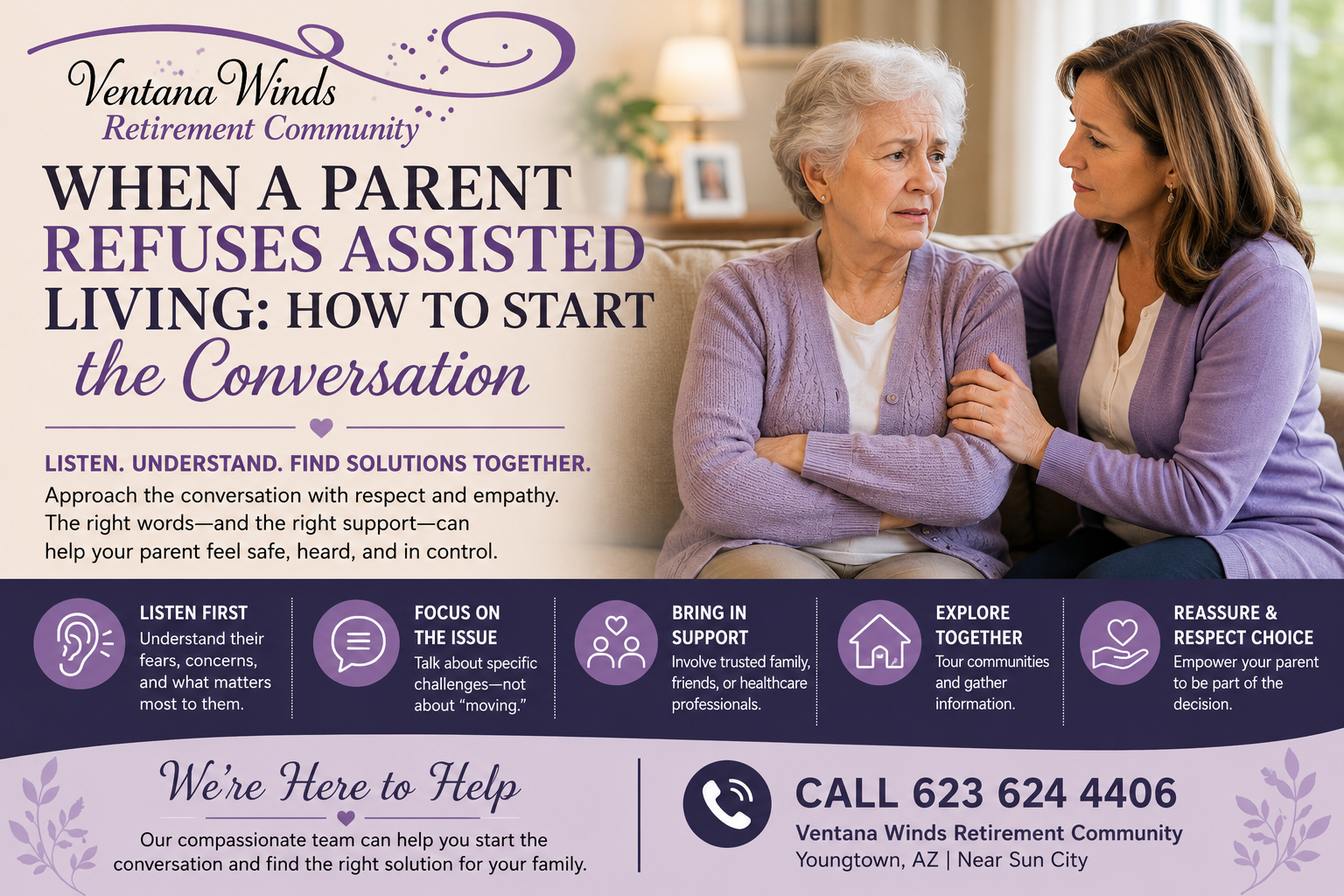
How To Talk To A Parent Who Refuses Assisted Living

How To Talk To A Parent Who Refuses Assisted Living

How To Talk To A Parent Who Refuses Assisted Living

The first conversation about assisted living rarely goes exactly as planned. An adult child arrives with sensible reasons, while the parent hears only one message: you think I can no longer manage my own life.

Learning how to talk to a parent who refuses assisted living begins with listening. Resistance is not always denial or stubbornness. It may come from fear of losing privacy, familiar routines, possessions, neighbours, control, or the identity built around a long held home.

Start With The Problem, Not The Destination

Opening with, “You need to move,” puts the entire conversation on one decision. A better beginning is a specific concern that both people can examine.

Perhaps meals are being skipped. The laundry has become difficult. Driving after dark no longer feels safe. A recent fall has changed confidence. One family member is trying to cover every appointment and household task.

Use plain examples without presenting a prosecution case. “I noticed there was no food in the refrigerator on Sunday” is easier to discuss than “You cannot look after yourself anymore.”

It should identify which parts of daily life are no longer working well.

Ask What Your Parent Wants To Protect

Most older adults value independence, but that word can mean different things. It may mean choosing when to wake up, seeing friends, attending church, or not asking a daughter to handle every small task.

Ask what your parent most wants to preserve. Then discuss whether assisted living could support those priorities. Prepared meals may make it easier to eat regularly. Transportation may protect access to appointments and shopping. Help with housekeeping can leave more energy for enjoyable parts of the day.

Do Not Argue About Every Objection

A parent may say assisted living is only for people who are very ill, the apartments will feel cramped, or everyone will interfere. Correcting every statement immediately can make the conversation feel like a contest.

Ask what is behind the objection. “What worries you most about it?” often reveals more than another list of benefits. The real concern may be money, a pet, privacy, unfamiliar food, or fear that family visits will become less frequent.

Some objections can be answered with facts. Others need time. Repeating the same argument more forcefully rarely makes it more persuasive.

Offer A Tour Without Demanding A Commitment

A tour can replace imagined fears with something concrete. Present it as information gathering, not a trap. Your parent is allowed to dislike the first place, ask difficult questions, and compare options.

Look at an apartment, dining room, outdoor area, and activity calendar. Ask how residents control their routines and how care plans are developed. Let your parent speak directly with staff.

Afterward, do not begin the sales pitch in the car park. Ask what felt comfortable and what did not.

Bring In The Right Outside Voice

Some parents hear concerns more easily from a physician, trusted friend, clergy member, or relative who is not involved in the daily tension. The outside person should not ambush or gang up on them. Their role is to help discuss safety, care needs, and realistic options.

When memory, judgment, or decision making appears to have changed, seek appropriate medical and legal guidance. A family disagreement cannot determine whether someone has the capacity to make their own choices.

Know When Safety Changes The Conversation

A competent adult can make choices other people consider unwise. Families can still set limits on what they are able to provide. It is reasonable to say that one person cannot continue covering overnight supervision, meals, transportation, and personal care alone.

Repeated wandering, serious medication errors, unsafe driving, or an inability to obtain food requires prompt professional help. Safety planning should not wait for the perfect conversation.

Begin A Calmer Assisted Living Conversation At Ventana Winds

Ventana Winds offers assisted living in Youngtown near Sun City with spacious apartments, individualized care plans, chef prepared meals, housekeeping, laundry, activities, transportation, and 24 hour staffing. Call 623 624 4406 to arrange a no pressure tour and give your parent the chance to see the community, ask questions, and take part in the decision.

Live References

Ventana Winds Assisted Living

https://www.ventanawinds.com/assisted-living.htm

AARP: How To Care For An Aging Parent Who Resists Help

https://www.aarp.org/caregiving/life-balance/when-aging-parents-resist-help/

National Institute on Aging: Does An Older Adult In Your Life Need Help?

https://www.nia.nih.gov/health/caregiving/does-older-adult-your-life-need-help

National Institute on Aging: Aging In Place

https://www.nia.nih.gov/health/aging-place/aging-place-growing-older-home

Written by webtechs

When Is It Time For Memory Care? 6 Important Signs


When Is It Time For Memory Care? 6 Important Signs

Families rarely receive one unmistakable signal that it is time for memory care. The decision usually develops through a series of changes involving safety, personal care, behavior, health, and the amount of support a person needs each day.

Occasional forgetfulness does not automatically mean someone needs residential memory support. A medical evaluation is important when memory loss or confusion begins affecting daily life. Once a diagnosis has been made, families can watch for practical signs that care at home is becoming difficult or unsafe.

Wandering Or Getting Lost Has Become A Concern

A person living with dementia may leave home unexpectedly, become confused in a familiar neighborhood, or try to return to a place from many years ago. Wandering can happen at different stages of dementia and may place someone at serious risk, particularly during extreme Arizona heat.

Door alarms, identification information, supervision, and changes to the home may help for a time. When a person requires constant monitoring to remain safe, a secured memory care setting may deserve serious consideration.

Everyday Tasks Are No Longer Completed Safely

Look beyond memory lapses and consider how well the person manages ordinary routines. Unopened mail, unpaid bills, spoiled food, missed meals, medication errors, scorched cookware, and poor housekeeping may show that independent living is becoming harder.

Personal hygiene can also change. A loved one may wear the same clothing repeatedly, resist bathing, or forget how to complete familiar tasks. These changes should be discussed with a healthcare professional, since infections, medication effects, depression, and other conditions can sometimes cause sudden confusion.

Behavior Or Personality Has Changed

Dementia can affect judgment, communication, mood, and behavior. A person who was previously relaxed may become suspicious, anxious, withdrawn, or easily agitated. Late afternoon or evening confusion may make care particularly difficult.

Memory care teams are trained to respond to these changes with structure, reassurance, familiar routines, and activities adapted to the resident’s abilities. The goal is not simply to supervise behavior. It is to understand what the person may be communicating through it.

Physical Health Is Declining

Weight loss, dehydration, frequent falls, disrupted sleep, and reduced mobility may suggest that the current care arrangement is no longer meeting every need. A person with dementia may forget to drink, lose interest in food, or have difficulty explaining pain and illness.

Families should seek medical guidance when physical changes appear. If regular meals, hydration, medication support, and daily observation cannot be maintained at home, residential memory care may provide a more consistent routine.

The Family Caregiver Is Exhausted

Caregiver health matters. Constant supervision, interrupted sleep, lifting, personal care, and repeated emergencies can become overwhelming. Exhaustion may affect patience, decision making, work, relationships, and the caregiver’s own health.

Needing additional support is not a failure. It may mean that the level of care has grown beyond what one person or family can safely provide. The National Institute on Aging notes that residential care may become appropriate when an older adult needs more support than relatives and friends can provide.

Home No Longer Provides Enough Engagement

People living with dementia can still benefit from music, conversation, movement, familiar tasks, and meaningful social contact. Isolation may increase when leaving home becomes difficult or a family caregiver has little time left for activities.

A dedicated memory support program can provide a predictable schedule and activities suited to different abilities. Ventana Winds uses its Elements Memory Support program to encourage engagement, individual choice, social connection, and a strength based approach in a secured environment.

Explore Memory Care At Ventana Winds

Ventana Winds provides compassionate memory care in Youngtown near Sun City for people living with Alzheimer’s disease, dementia, and other memory disorders. Families can learn about the Elements Memory Support program, secured accommodations, dining, activities, and current availability by calling Ventana Winds at 623 624 4406 to arrange a personal visit.

References

Ventana Winds Elements Memory Support

National Institute On Aging: Wandering And Getting Lost

National Institute On Aging: Managing Personality And Behavior Changes

National Institute On Aging: Frequently Asked Caregiving Questions

Written by webtechs

Assisted Living Near Sun City: Tour Checklist

Assisted Living Near Sun City: Tour Checklist

Assisted Living Near Sun City: Tour Checklist

Assisted Living Near Sun City: What To Look For During A Tour

Choosing assisted living is easier when families know what to look for before they walk through the door. A beautiful lobby matters, but it does not tell you how daily life feels, how care needs are handled, or whether a resident will feel comfortable after the first week.

When touring assisted living near Sun City, arrive with a short list of priorities. Consider current health needs, preferred apartment size, transportation, meals, social interests, and the amount of help required each day. A focused tour makes it easier to compare communities fairly and avoid making a decision based only on first impressions.

Ask How Personal Care Plans Are Created

Assisted living should provide support without taking away independence. Ask how the community evaluates a new resident and how that information becomes a personal care plan. Families should understand who completes the assessment, which services can be added, and how often needs are reviewed.

It is also useful to ask what happens after an illness, fall, hospital visit, or noticeable change in mobility. A community should be able to explain how it communicates with families and adjusts support when circumstances change.

Look Closely At The Apartment

Tour the type of apartment your loved one may actually occupy, not only a decorated model. Look at the walking distance to dining and activity areas, bathroom accessibility, storage, lighting, emergency call systems, and space for familiar furniture.

Ventana Winds offers one and two bedroom assisted living apartments with walk in closets, private patios or balconies, kitchenettes, and individual climate controls. Details like these can help a new apartment feel more like a home than a temporary room.

Review Meals, Activities, And Transportation

Daily routines often determine whether a resident settles in successfully. Ask to see a current activity calendar and sample menu. Find out whether residents can choose among activities rather than being expected to follow one schedule.

Meals deserve more than a quick glance at the dining room. Ask how dietary needs are handled, whether snacks are available, and what happens if a resident misses a scheduled meal. Transportation should also be discussed, especially for medical appointments, shopping, and community outings.

Ask About Staffing And Communication

Families should know who is available during the day, overnight, and on weekends. Ask which team members provide personal assistance, who manages medications, and who should be contacted with a concern.

Observe how staff members speak to residents during the tour. Respectful conversation, patience, and familiarity can reveal more than a prepared presentation. Ask how families receive updates and whether there is a regular process for discussing changes in care.

Understand The Complete Monthly Cost

Request a clear explanation of base rent and additional care charges. Ask which services are included, which are billed separately, and how costs may change if a resident needs more assistance.

Ventana Winds includes three daily meals and snacks, utilities, housekeeping, laundry, activities, maintenance, an emergency call system, and scheduled transportation in its monthly base rent. Care services are based on the resident’s individual plan, so families should discuss likely charges before choosing an apartment.

Pay Attention To The Community Atmosphere

A good tour should include time to observe ordinary life. Are residents using the common areas? Do activities appear welcoming? Is the dining room active? Does the community feel calm without feeling empty?

The right assisted living community should support safety and personal care while still offering privacy, choice, and meaningful social contact. Families may benefit from returning at a different time of day before making a final decision. The National Institute on Aging recommends visiting facilities, speaking with staff and residents, reviewing services, and carefully comparing available choices.

Tour Ventana Winds Near Sun City

Ventana Winds provides assisted living in Youngtown near Sun City, with spacious apartments, chef prepared meals, scheduled transportation, activities, and professional staff available 24 hours a day. To ask about current availability, apartment options, or personal care services, call Ventana Winds at 623 624 4406 and schedule a private tour.

References

Ventana Winds Assisted Living

National Institute On Aging: Choosing A Long Term Care Facility

Arizona Department Of Health Services: AZ Care Check

Sundowning can cause greater confusion and restlessness later in the day. Learn what families may notice and how they can respond.
Written by webtechs

Sundowning And Dementia: Why Evenings Can Be Difficult

At four in the afternoon, Mom is relaxed and talking about her garden. By six, something has shifted. She wants to know who moved her purse. She asks when she is going home, although she is already there. A few minutes later, she is checking the front door.

Families sometimes wonder whether they said or did something wrong. Usually, they did not. The change may be connected to sundowning, a term used when confusion or restlessness becomes more noticeable late in the afternoon or during the evening.

Sundowning is not a separate disease. It is a pattern that can affect people living with Alzheimer’s disease or another form of dementia.

Why Does Sundowning Happen?

There is no tidy explanation that applies to everyone. By evening, a person may simply be tired after spending all day trying to understand conversations, rooms, faces, and ordinary tasks.

The fading light can make familiar surroundings look different. A dark hallway may feel threatening. Reflections appear in windows. A coat hanging near the door can briefly resemble a stranger.

Then there are the everyday causes of discomfort. Perhaps the person is hungry but cannot explain it. They may need the bathroom, feel too warm, or have pain that has not been noticed. A loud television and several people talking at once can make an already confusing room feel impossible.

It helps to pay attention to what happens before the difficult period begins. Does Dad become unsettled on days without much activity? Does the confusion start when curtains are left open after dark? Is it worse after a late appointment? A simple notebook can reveal details that are easy to miss during a stressful evening.

What Should Families Do?

Start with the tone of the room. Slow things down. Turn off unnecessary noise and make sure there is enough light to reduce shadows.

Long explanations often create more frustration. If Mom insists she must collect her children from school, correcting every detail is unlikely to bring comfort. A calmer response might acknowledge that she is worried about them, then gently move the conversation toward a familiar photograph, music, or a small task.

Routine can make the day easier to follow. Meals, waking, bathing, and bedtime can happen at roughly familiar times. Daylight and appropriate activity earlier in the day may also support a steadier sleep schedule.

Try to avoid filling the late afternoon with demanding errands. What seems like a quick appointment to everyone else may leave a person with dementia tired and overwhelmed by evening.

When A Change Is More Than Sundowning

A sudden increase in confusion should be discussed with a healthcare professional. Infection, pain, dehydration, constipation, medication changes, and other medical issues may affect behavior.

This distinction matters in Arizona during summer. Dehydration can develop quickly, and a person with dementia may not recognize or communicate thirst.

Get immediate help when the person may harm themselves, leave the property, collapse, or cannot be kept safe. Families do not have to manage a dangerous situation alone.

Memory Care At Ventana Winds

Repeated evening confusion can wear down both the person experiencing it and the family trying to help. Memory care provides a more consistent setting, familiar routines, trained caregivers, and meaningful daily activities.

Ventana Winds offers memory care through its Elements Memory Support program in Youngtown near Sun City. Call 623 624 4406 to learn about current availability or schedule a visit.

References

National Institute on Aging
https://www.nia.nih.gov/health/alzheimers-changes-behavior-and-communication/coping-agitation-aggression-and-sundowning

Alzheimer’s Association
https://www.alz.org/help-support/caregiving/stages-behaviors/sleep-issues-sundowning

Ventana Winds Memory Care
https://www.ventanawinds.com/memory.htm

Ventana Winds Elements Memory Support
https://www.ventanawinds.com/elements-memory-support.htm

Signs Of Dehydration In Seniors During Arizona Summer
Written by webtechs

Signs Of Dehydration In Seniors During Arizona Summer

The water glass on the kitchen counter is still full at dinner. Mom says she was not thirsty, so she did not drink it. On an ordinary day, that might pass without much thought. During July in Arizona, it deserves attention.

Adults aged 65 and older are more vulnerable to heat related health problems. Dehydration can develop before a person realizes how much fluid has been lost, particularly when thirst is not a reliable reminder.

Families should know what to watch for and when a change needs medical attention.

Why Older Adults Can Become Dehydrated

The body changes with age. Older adults may not notice thirst as quickly as they once did. Mobility problems can make getting up for a drink inconvenient, while bladder concerns may lead someone to intentionally limit fluids.

Memory loss adds another difficulty. A person living with dementia may forget when they last drank, decline a beverage without understanding why it is being offered, or struggle to explain that they feel unwell.

Some medications and medical conditions can also affect hydration or the way the body responds to heat. A senior who has been given fluid restrictions should follow medical advice. Family members should not independently change those instructions during hot weather.

Early Signs Of Dehydration

Dry mouth, tiredness, dizziness, headache, and reduced urination can appear when the body needs more fluid. Urine may also become darker than usual.

The clues are not always obvious. A senior may seem unusually quiet, weak, irritable, or unsteady. Someone who usually prepares lunch might decide eating is too much trouble. Another person may spend the afternoon sleeping in a warm room.

Confusion deserves particular attention. It may occur with dehydration, but it can also have many other causes. A sudden change in alertness, behavior, or thinking should not simply be dismissed as aging.

Heat Exhaustion And Heat Stroke

Heat exhaustion may involve heavy sweating, weakness, nausea, headache, dizziness, thirst, and an elevated body temperature. Move the person to a cooler setting and seek medical guidance.

Heat stroke is an emergency. Warning signs can include a very high body temperature, fainting, seizures, slurred speech, marked confusion, or unusual agitation. Call 911 when heat stroke is suspected.

Do not wait for someone to ask for help. A person experiencing severe heat illness may not understand what is happening.

Making Hydration Part Of The Day

A large bottle placed on the table may not be enough. Smaller drinks offered throughout the day can feel more manageable. Water, appropriate juices, and other beverages approved by the person’s healthcare provider can add variety.

Meals also create useful reminders. Offer a drink with breakfast, lunch, dinner, medication routines, and afternoon snacks. Fruit and other foods with a high water content may contribute to overall fluid intake.

Keep commonly used rooms comfortably cool. Outdoor errands and walks should be planned for safer times of day, though extreme Arizona heat can remain dangerous even in the morning.

Regular check ins matter for seniors living alone. Confirm that the air conditioning is working and look beyond the standard question, “Are you drinking enough?” Check the refrigerator, notice changes in energy, and see whether beverages are actually being consumed.

Assisted Living In Youngtown, Arizona

Ventana Winds offers assisted living and memory care in Youngtown near Sun City. Residents enjoy comfortable apartments, meals, activities, and support with everyday needs in a welcoming community.

Call Ventana Winds at 623 624 4406 to schedule a tour and learn more about current availability.

References

Centers for Disease Control and Prevention
https://www.cdc.gov/heat-health/risk-factors/heat-and-older-adults-aged-65.html

National Institute on Aging
https://www.nia.nih.gov/health/safety/hot-weather-safety-older-adults

Johns Hopkins Medicine
https://www.hopkinsmedicine.org/health/conditions-and-diseases/dehydration-and-heat-stroke

Ventana Winds Retirement Community
https://www.ventanawinds.com/assisted-living.htm

About Ventana Winds

Ventana Winds Retirement Community is a member of SLS Communities and offers Assisted Living and Memory Care services In Youngtown, Arizona.

More Articles About Senior Living

1 2 3 … 5